Malware Detection & Signature Analysis using YARA & ClamAV
Executive Summary
This report details the technical processes and findings from a comprehensive Malware Analysis Lab focused on utilizing YARA and ClamAV for threat detection. The primary objectives included analyzing ClamAV database signatures (.ndb), extracting and decoding hex/assembly patterns, engineering custom detection rules, and deploying YARA rules to identify specific adversarial behaviors such as process injection, keylogging, and extension spoofing. The findings emphasize the efficacy of signature-based and heuristic-based detection mechanisms in a Security Operations Center (SOC) environment.
1. Environment Preparation & Baseline Setup
The analysis environment was initialized by updating the ClamAV virus database using the command sudo freshclam, ensuring the detection engine possessed the latest threat signatures.

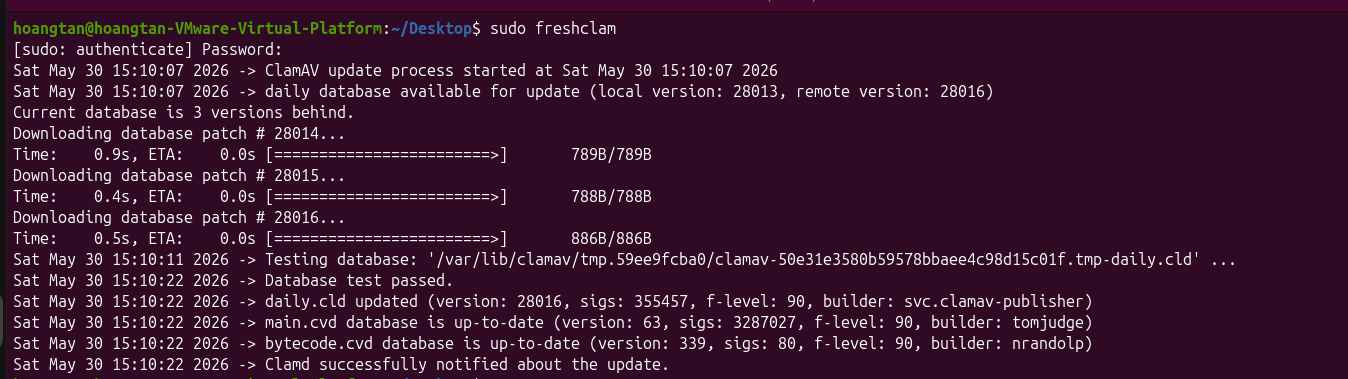 Figure 1 & 2: ClamAV database update sequence.
To simulate a malware encounter, several text files containing simulated malicious strings were generated.
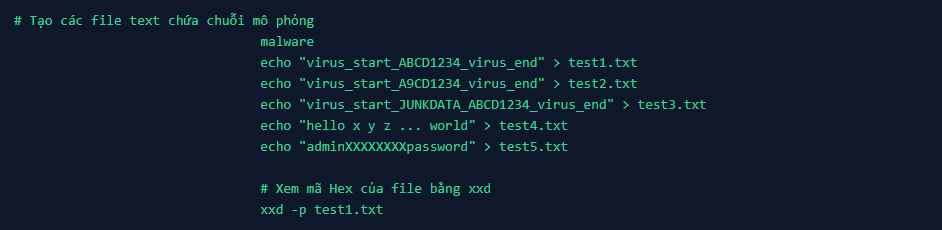
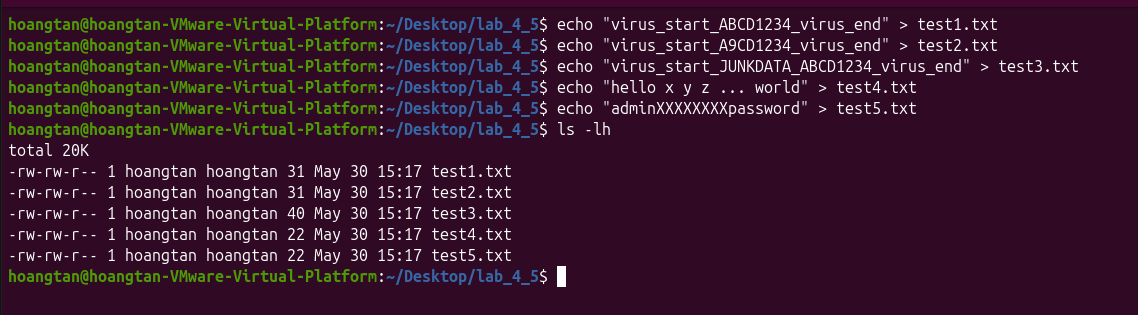
A preliminary inspection of the simulated files was conducted using the xxd utility.

[!TIP] The
xxdutility is highly effective for examining the raw hex content of a file. It is a critical tool for detecting hidden characters, crafting antivirus signatures, and conducting deep forensic analysis.
2. ClamAV Database Analysis & Signature Reverse Engineering
Signature Identification
The ClamAV database was queried to identify specific detection rules. A targeted directory containing malware samples was scanned using clamscan to observe the triggered signatures.
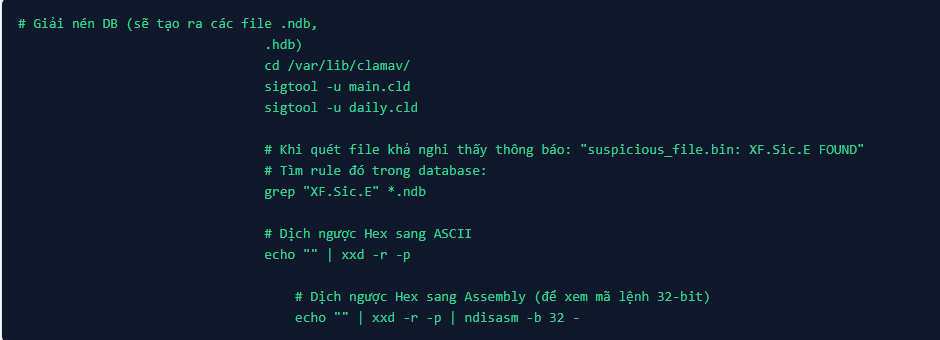
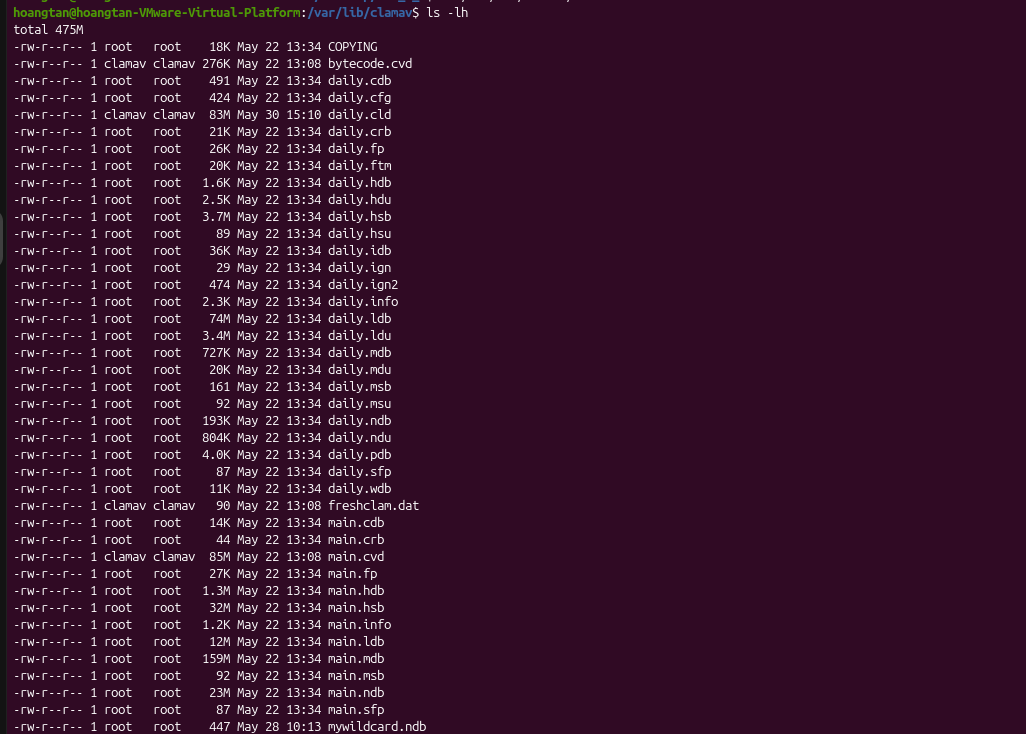
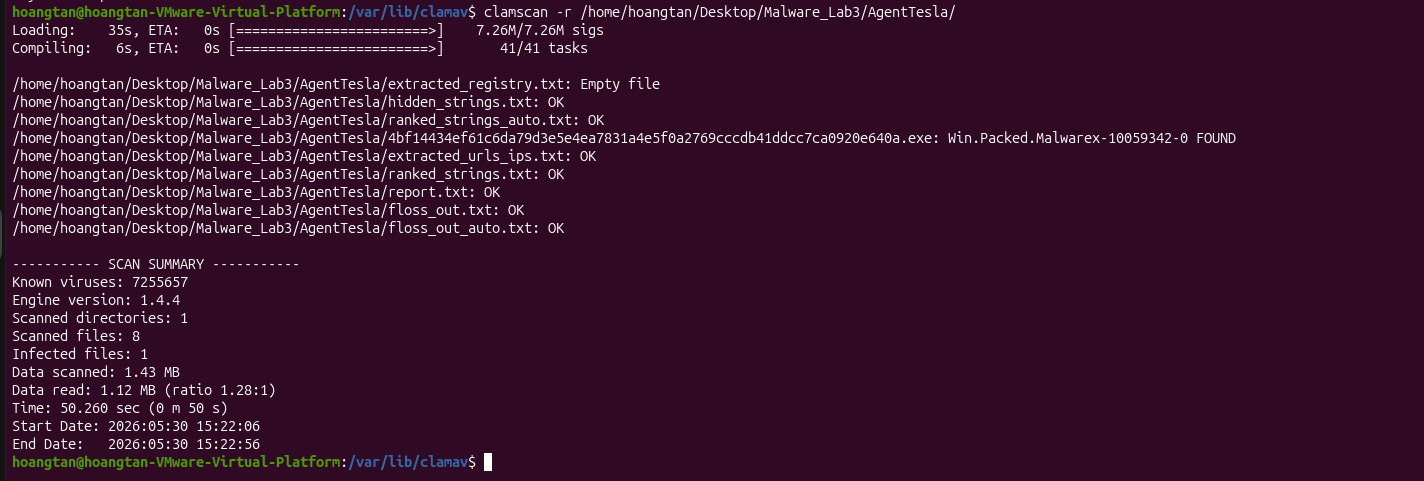
The scan successfully triggered the signature Win.Packed.Malwarex-10059342-0. Further investigation located this signature within the daily.ldb database file.

Hex to Assembly Decoding
The extracted signature contained raw bytecode. To interpret this machine code, the ndisasm disassembler was employed to translate the hex into readable Assembly (ASM) instructions.

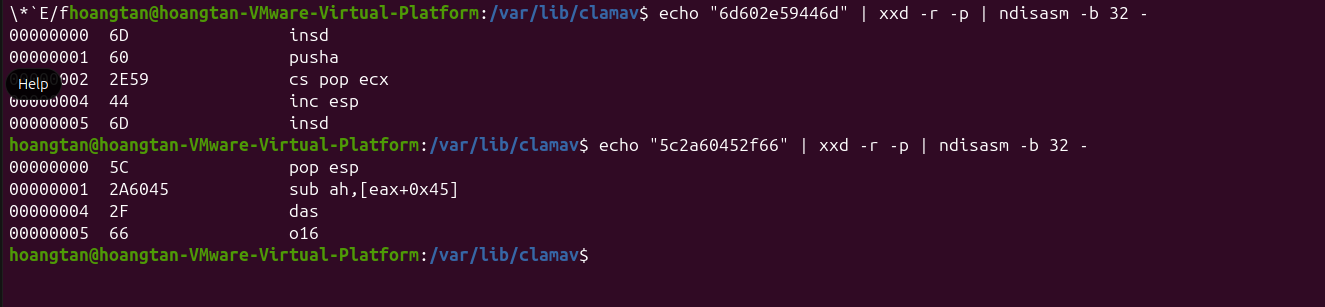
Behavioral Analysis of the Disassembled Code: The identified ASM instructions are characteristic of a Malware Packer/Stub. The primary function of this stub is to self-decrypt and unpack the malicious payload into memory, thereby evading static AV detection.
insd,pusha: Retrieves the execution address and preserves the state of CPU registers prior to decryption.cs pop ecx: Executes a memory context switch to access the packed data.sub ah, [eax+0x45],das: The core decryption routine (often utilizing subtraction or XOR operations) designed to restore the original machine code from the obfuscated data.
[!IMPORTANT] This stub acts as a protective shell, allowing the malware to remain dormant and encrypted on the disk, only revealing its true malicious form during in-memory execution.
3. Custom Signature Engineering & Deployment
A custom signature database (mywildcard.ndb) was engineered using the standard format: Malware_Name:Target:Offset:Hex_String.

The creation of custom .ndb files serves three strategic purposes:
- Zero-Day Detection: Provides ClamAV with indicators of compromise (IoCs) for novel malware not yet present in the global database.
- Proactive Triage: Enables the definition of localized, environment-specific scanning rules.
- Structural Research: Facilitates a deeper understanding of how ClamAV parses and matches logical signatures.
A validation scan was executed using the custom database: clamscan -d mywildcard.ndb test1.txt test2.txt test3.txt test4.txt test5.txt
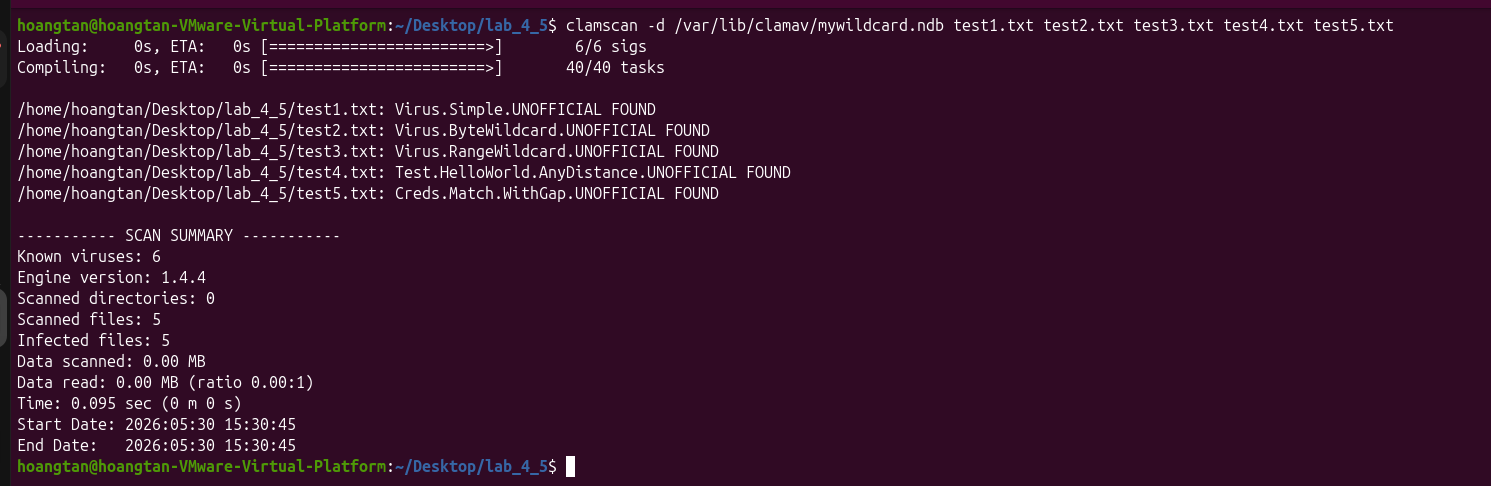
The results confirmed the successful loading, compilation, and execution of the custom rules, triggering .UNOFFICIAL alerts on the test files.
In-Depth Signature Analysis (ASCII & Bytecode)
Eight sample signatures were extracted from main.ndb and daily.ndb for deeper forensic analysis.
A. ASCII String Extraction
The first four signatures were parsed for readable ASCII content.

1. main.ndb:Doc.Trojan.Nori-1 
- Analysis: Contains strings like
CodeModule.Lines,Components.Item, and<> "'Iron" Then. - Conclusion: This signature targets malicious VBA macros embedded in Microsoft Office documents. The strings suggest self-modifying code or logic designed to inspect the VBA project structure, a common tactic for evading detection or hiding malicious logic.
2. main.ndb:Win.Trojan.Dialer-1 
- Analysis: Reveals fragments like
http://...,.exe,Software\Web..., andPassw.... - Conclusion: Indicates behavior associated with payload downloading (HTTP/EXE), persistent configuration via the Windows Registry (
Software\...), and potential credential theft (Passw...).
3. main.ndb:Win.Trojan.GWGirl-1 
- Analysis: Decodes to
.com,DXInput.dll,G2h7o2st_Event, and\SCANREGW.EXE. - Conclusion: Targets suspicious DLL loading (
DXInput.dll), specific synchronization objects/mutexes (G2h7o2st_Event), and potential masquerading using legacy Windows system files (SCANREGW.EXE).
4. main.ndb:Win.Trojan.DeltaV1-1 
- Analysis: Extracts
.com,Delta v1.0 by Retro, andhttp:/. - Conclusion: Identifies a likely legacy virus targeting
.comexecutables, characterized by a specific author/tool artifact (Delta v1.0 by Retro).
B. Bytecode (Assembly) Decoding
The remaining four signatures were decoded using ndisasm to analyze the underlying operational logic.

1. Win.Worm.Gaobot-1 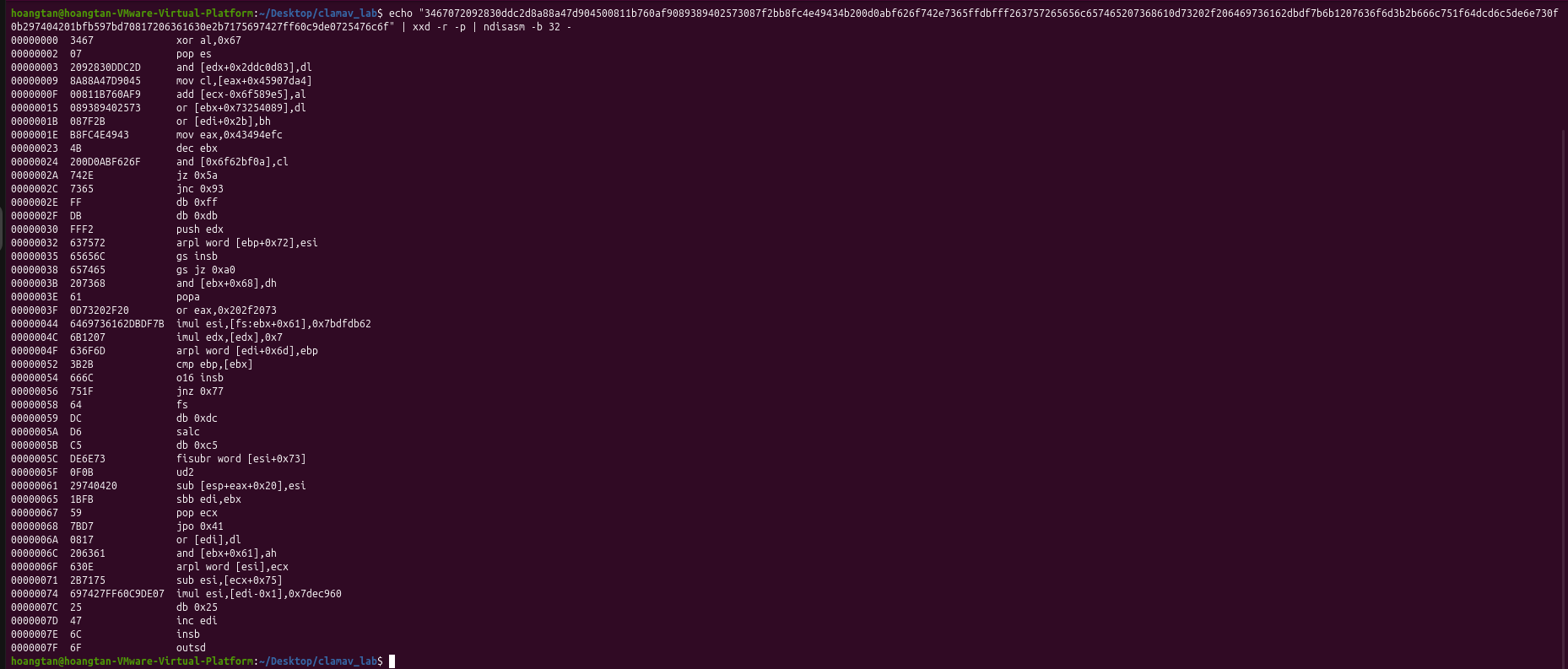
- Analysis: Contains direct register manipulation (
xor al,0x67,and,or) and conditional branching (jz,jnc,jnz). - Conclusion: The signature targets specific byte-level logic and conditional execution flows, indicative of obfuscated or structurally unique machine code rather than simple string matching.
2. Win.Worm.Bormex-1 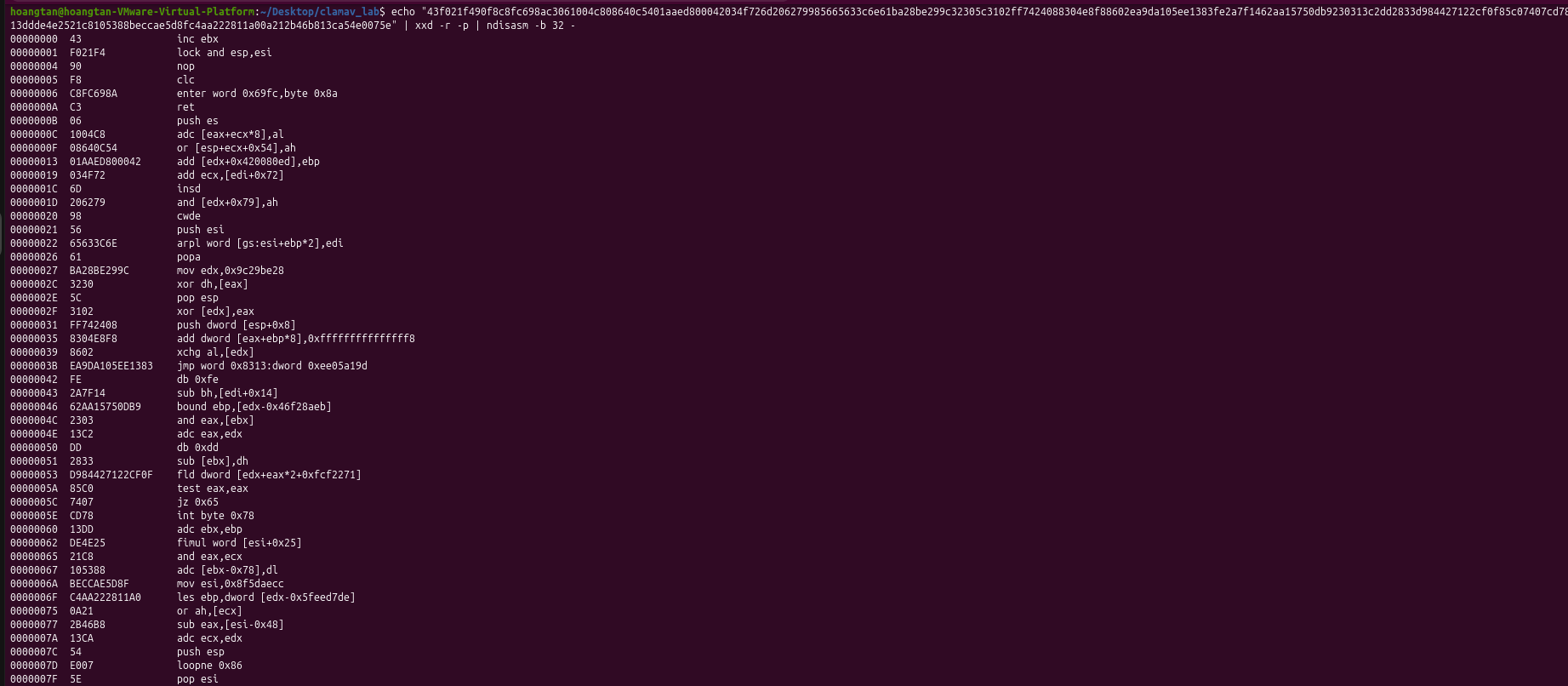
- Analysis: Shows intensive register operations (
inc,adc,add,xor), stack manipulation (push), and conditional loops (loopne). - Conclusion: Represents a complex byte pattern designed to detect intricate data processing or highly obfuscated routines.
3. Vbs.Tool.Svbsvc-1 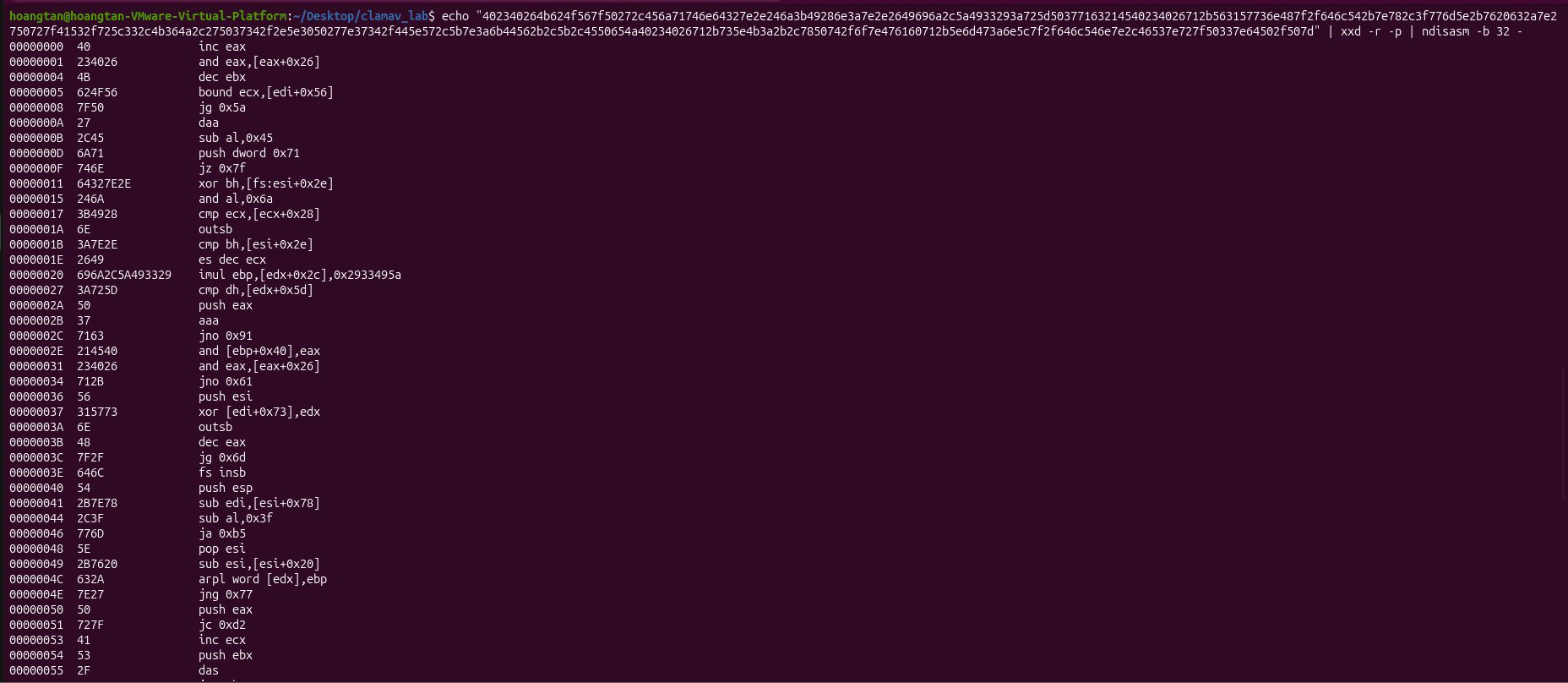
- Analysis: Features data comparison (
cmp), various conditional jumps (jg,jz,jno), and low-level I/O operations (outsb,insd). - Conclusion: Targets structural branching and low-level system interaction patterns.
4. Win.Ircbot.Netol-1 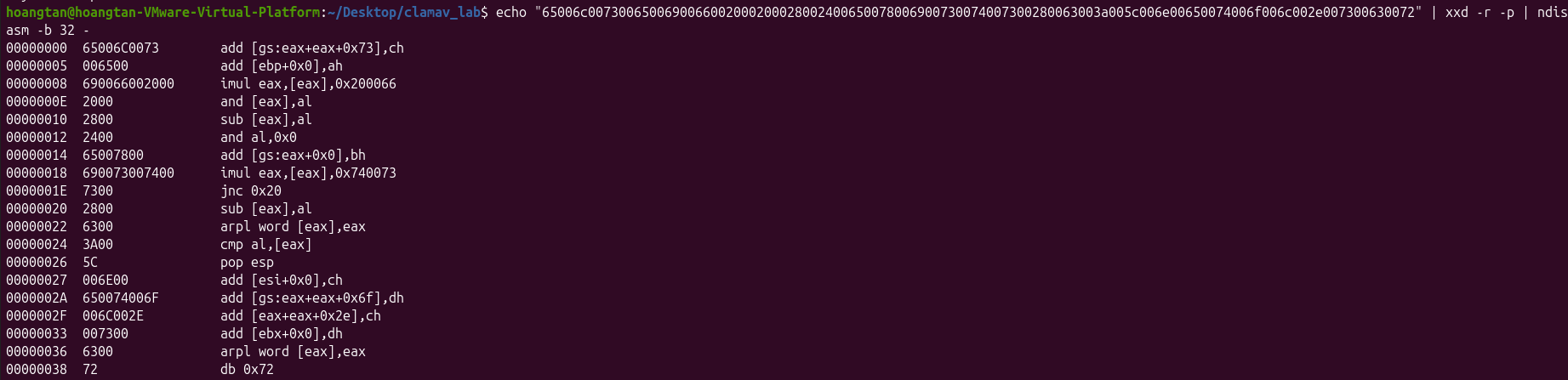
- Analysis: When properly interpreted as UTF-16LE, it reveals
elseif ($exists(c:\netol.scr. (Initially misinterpreted by ndisasm). - Conclusion: This signature is designed to detect a script checking for the existence of
c:\netol.scr. The.scr(screensaver) extension is frequently abused to mask executable malware payloads.
4. YARA Rule Development & Threat Hunting
YARA (v4.5.5) was deployed and utilized to hunt for specific behavioral indicators across a repository of known malware samples (The Zoo).

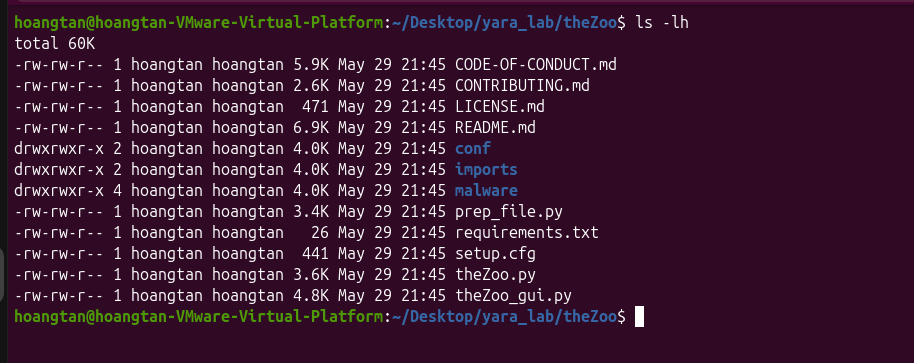
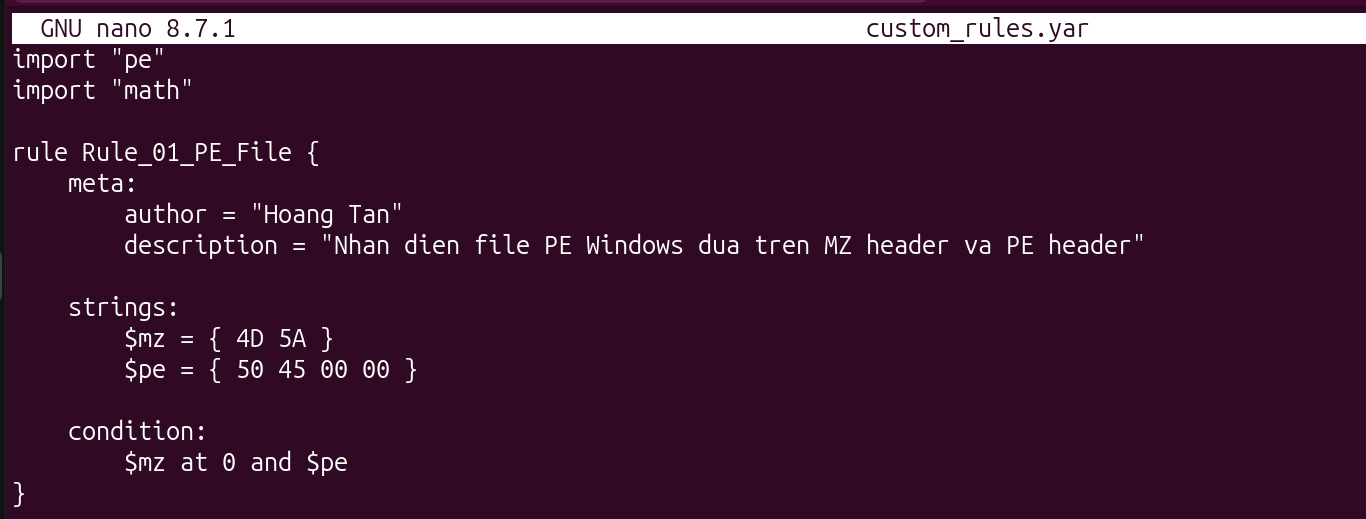
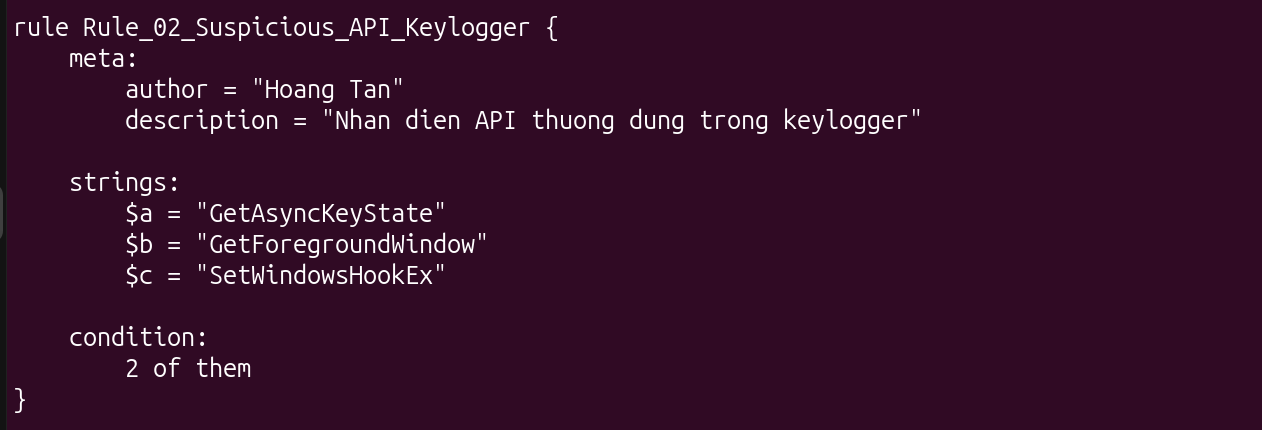
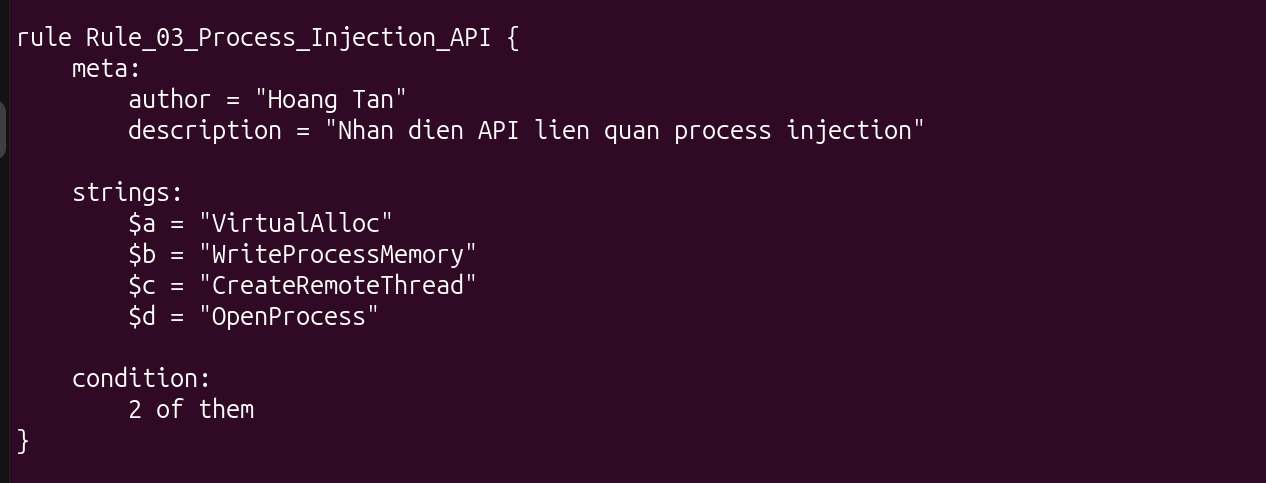
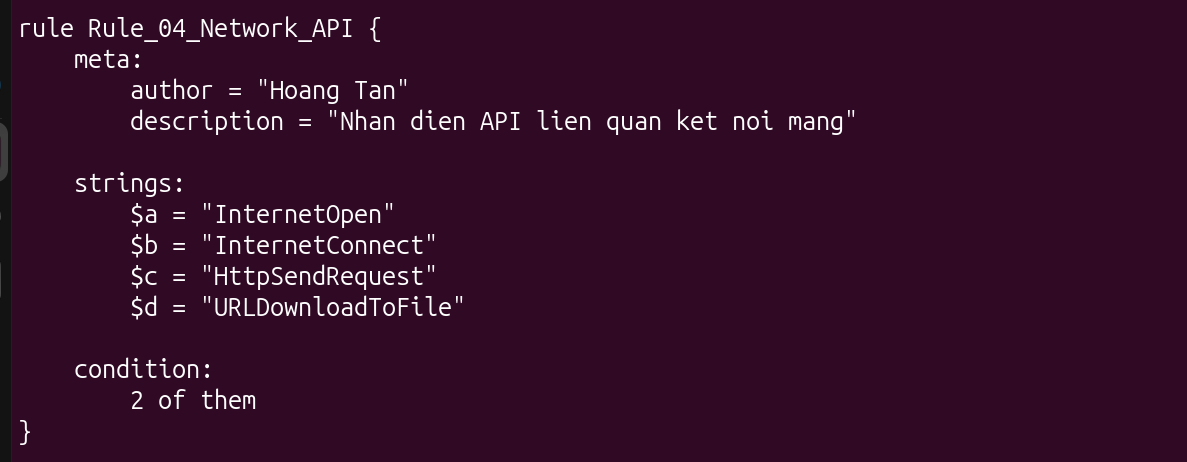
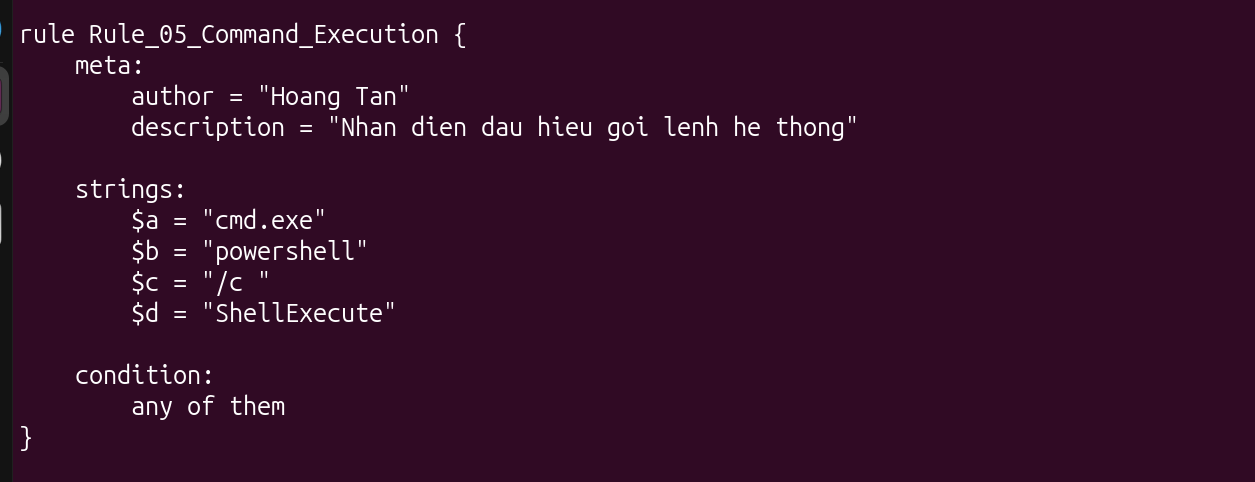
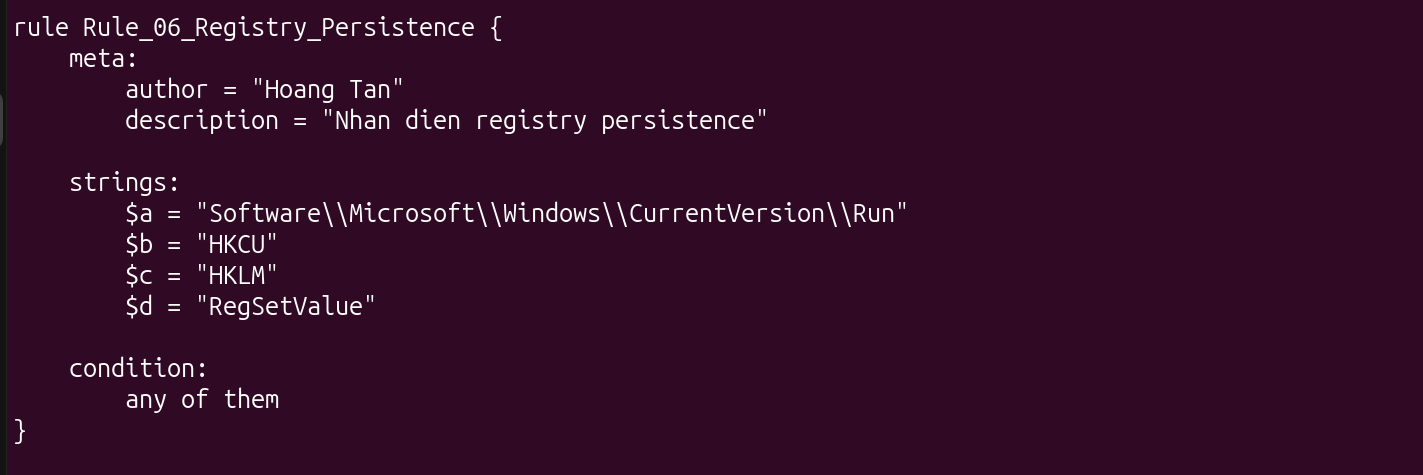
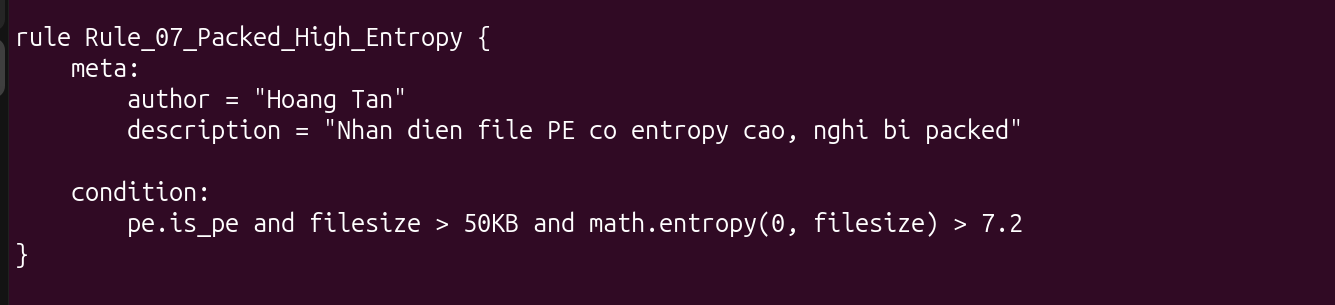
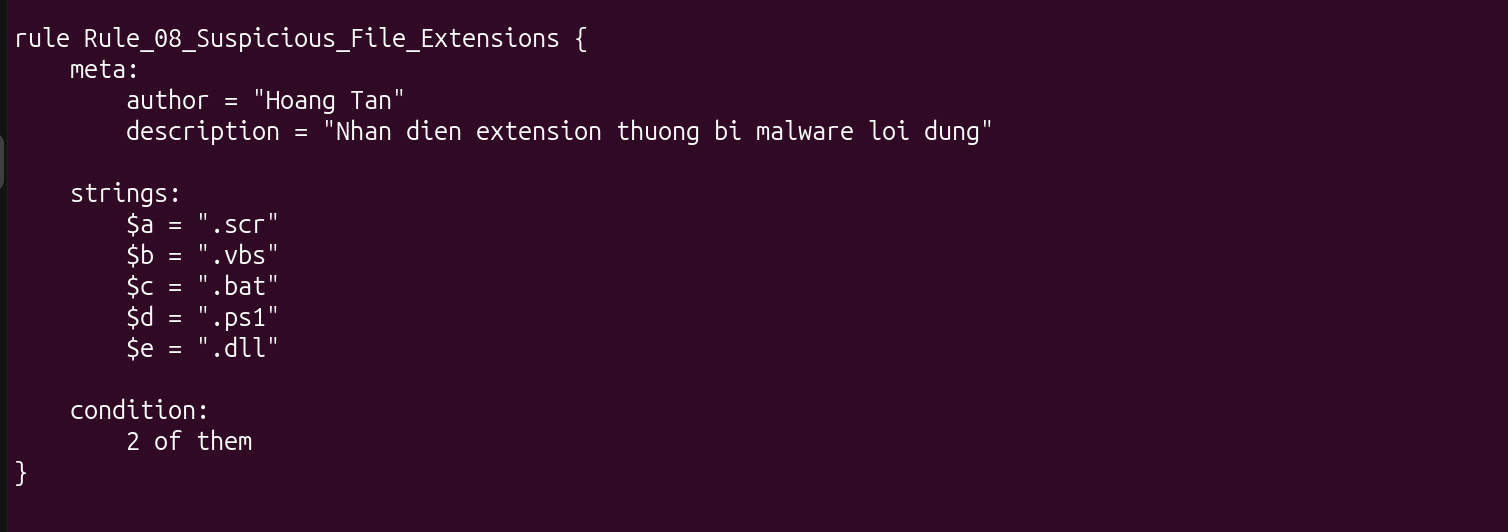
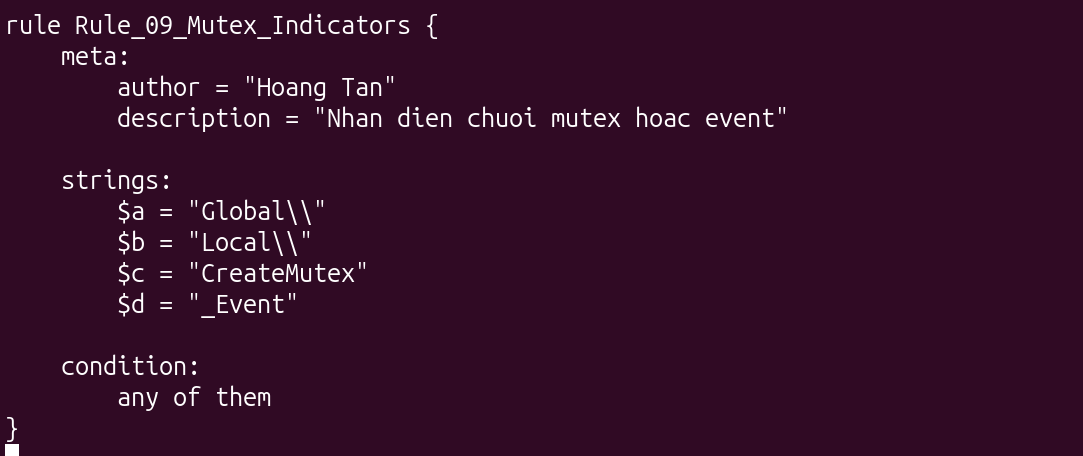
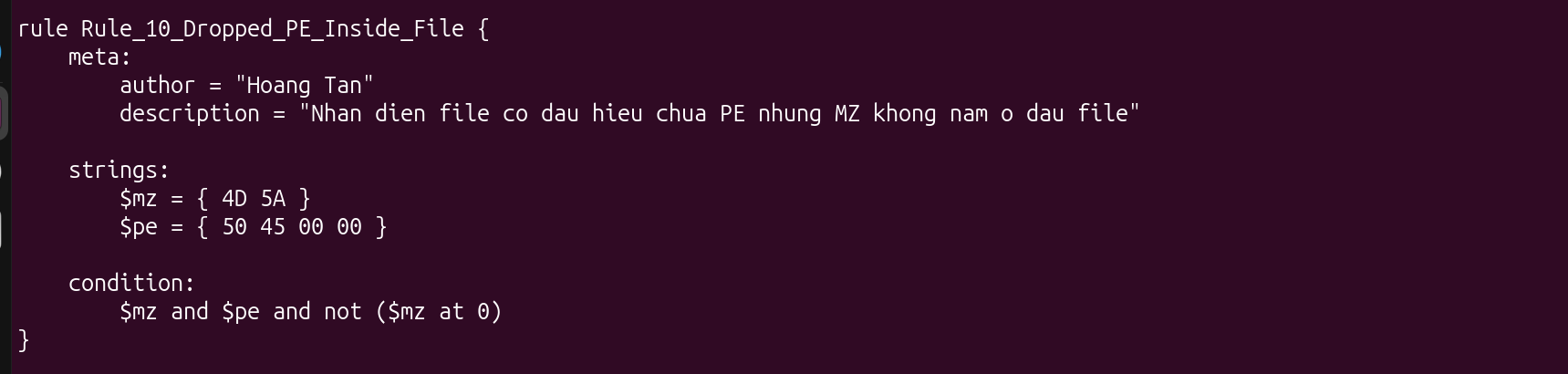
A comprehensive ruleset comprising 10 distinct YARA rules was engineered to detect various malicious capabilities:
- PE File Identification: Targets the
MZmagic bytes andPEheader. (Fig. 27) - Keylogger APIs: Detects combinations of keystroke logging and window tracking APIs. (Fig. 28)
- Process Injection APIs: Identifies memory allocation, remote thread creation, and process manipulation functions. (Fig. 29)
- Network Communication APIs: Flags HTTP requests and payload download mechanisms. (Fig. 30)
- System Command Execution: Searches for
cmd.exe,powershell, andShellExecute. (Fig. 31) - Registry Persistence: Identifies modifications to autorun keys (
Run,HKCU,HKLM). (Fig. 32) - High Entropy (Packed) PEs: Detects executables with entropy > 7.2, indicating packing or encryption. (Fig. 33)
- Suspicious File Extensions: Flags commonly abused extensions like
.scr,.vbs, and.ps1. (Fig. 34) - Mutex/Event Objects: Detects
CreateMutexor specific event string patterns used for infection marking. (Fig. 35) - Embedded PE Files: Identifies files where a PE header exists, but the
MZsignature is not at offset 0, indicating a dropped or embedded payload. (Fig. 36)
YARA Execution Results
The ruleset was executed against the theZoo repository: yara -r custom_rules.yar theZoo
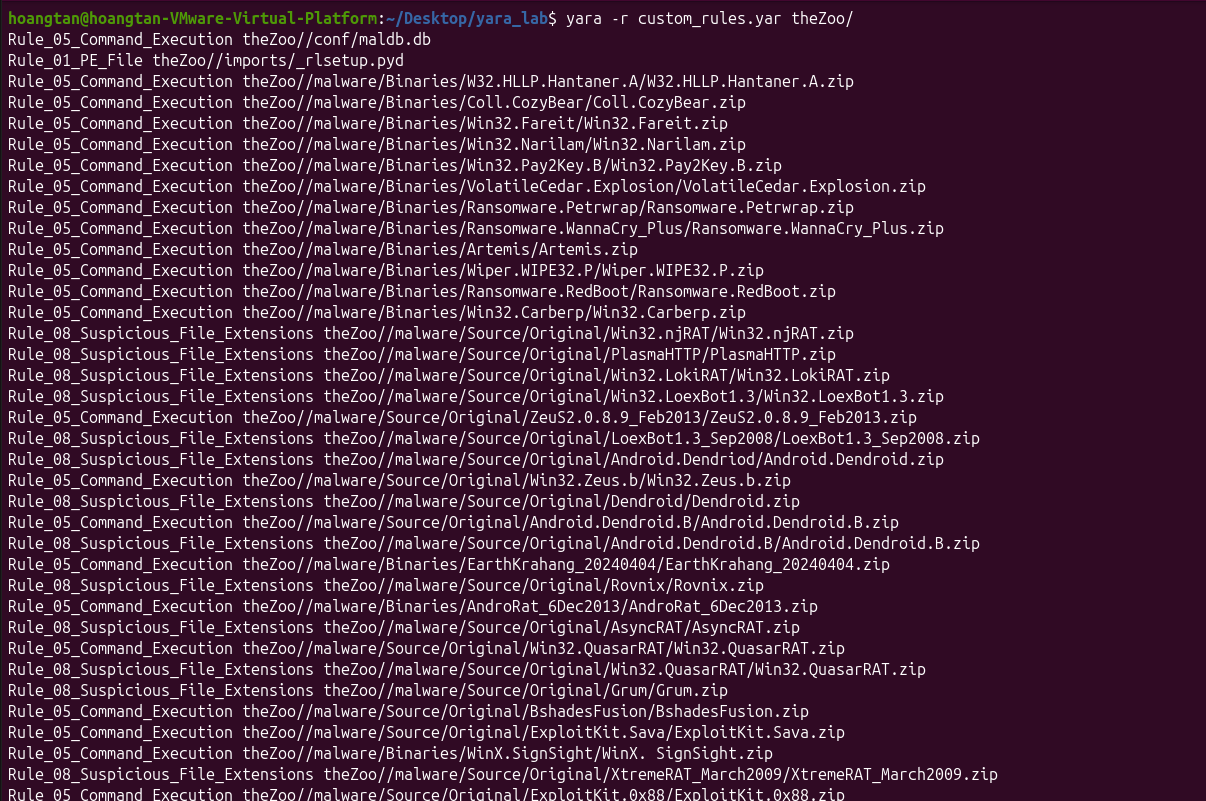
Key Findings from YARA Scan:
- Rule_05 (Command Execution) & Rule_08 (Suspicious Extensions): Triggered heavily across families like WannaCry, Zeus, AsyncRAT, and QuasarRAT, confirming their reliance on scripts and shell commands.
- Rule_10 (Embedded PE): Successfully detected
Android.CEREBRUS 2.zip.001/.002, indicating the presence of embedded executables within the archive fragments. - Rule_06 (Registry Persistence): Flagged objects within the
.gitdirectory. This is noted as a false positive caused by scanning version control history containing registry-related strings.
5. Practical Use Case: Detecting Extension Spoofing
A practical scenario was simulated involving Extension Spoofing, where an executable file is disguised as a benign text document.
A malicious file named invoice.txt was created, but its internal header began with 4D 5A (the MZ magic bytes of a PE file).

A specific YARA rule was crafted to detect this evasion technique:
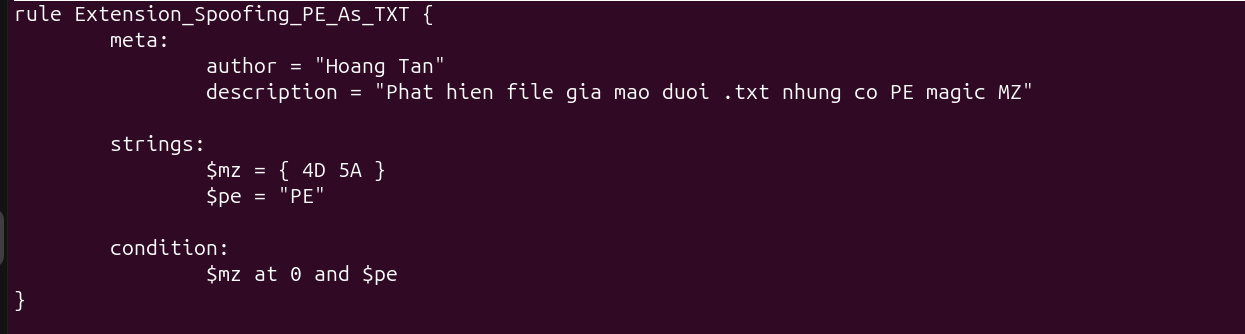
Rule Logic: The rule verifies if the MZ signature exists exactly at offset 0, AND the PE string is present, but the file extension (in a real-world scenario, evaluated by the scanning engine or analyst) does not match its internal structure.
The rule successfully identified the spoofed invoice.txt file.

6. Conclusion & SOC Recommendations
ClamAV excels at rapid, scalable scanning utilizing vast databases of known signatures (.ndb, .ldb). It is highly effective for identifying known threats but is susceptible to evasion techniques such as polymorphism, packing, and string obfuscation due to its reliance on static pattern matching.
YARA provides a highly flexible and powerful framework for threat hunting and static analysis. It empowers analysts to construct complex, logic-based rules targeting specific behaviors, APIs, entropy levels, and structural anomalies (like extension spoofing). However, poorly tuned YARA rules can lead to high false-positive rates (as seen with the .git directory scan).
Recommendation: For robust SOC operations, signature-based engines (ClamAV) should be utilized for initial triage and known-threat mitigation, while behavioral and heuristic-based engines (YARA) must be deployed for advanced threat hunting, detecting novel evasion techniques, and analyzing polymorphic malware families. Neither should act as a standalone solution; they must be integrated with dynamic analysis (sandboxing) and Endpoint Detection and Response (EDR) telemetry.